A Very Short History: Utility First, Then Identity
Loincloths and linen. Early underwear was purely functional: wraps and simple layers to reduce friction and protect skin. It wasn’t designed to be “sexy” — it was about comfort and practicality.
The jockstrap started as sports equipment. The modern jockstrap is commonly traced to late-19th-century cycling, created to reduce movement and chafing for bicycle riders. That athletic origin matters because sport culture helped turn certain underwear styles into symbols of masculinity, physique, and confidence — which later became part of their appeal in gay culture and fetish spaces.
Branding changed everything. In the late 20th century, elastic waistbands, designer labels, and advertising turned underwear into identity. It stopped being invisible and became something you actively choose — not just tolerate.
2020s: performance + fashion + kink. Today, fabrics and cuts have exploded in variety (modal, microfibre, bamboo blends, mesh, compression). Underwear now sits at the intersection of comfort, body image, and erotic aesthetics.
The Market Is Huge (and Still Growing)
Depending on how analysts define the category (men-only vs all underwear), reports often estimate the global underwear market at roughly $90B+, with men’s underwear alone commonly placed in the $40B–$80B range. That spread isn’t a contradiction — it reflects different definitions, regions, and product segments. The consistent story is growth, driven by e-commerce, premium materials, and the “athleisure” shift where people pay more for fit and comfort.
In plain terms: men buy more pairs, replace them more often, and treat underwear more like clothing than a basic necessity.
Who Wears What? The Global Split (and Why It Varies)
There isn’t one perfect global survey that captures everyone’s underwear drawer (people don’t always answer honestly, definitions vary, and preferences shift by season and activity). But across consumer surveys and market breakdowns, a few stable patterns show up:
Boxer briefs / trunks dominate in many Western markets because they balance support and coverage.
Loose boxers remain popular where airflow and relaxed comfort matter most.
Briefs hold stronger share in parts of Europe and Latin America, and they’re seeing a modern resurgence with younger, fashion-driven buyers.
Jockstraps are still niche for daily wear, but they’re disproportionately important in kink culture, nightlife, and fashion.
A YouGov UK survey found men split between loose boxers, tighter fitting boxers, and briefs — with loose boxers the single biggest group, and briefs not far behind. In the UK, briefs never fully disappeared; they just stopped being the default.
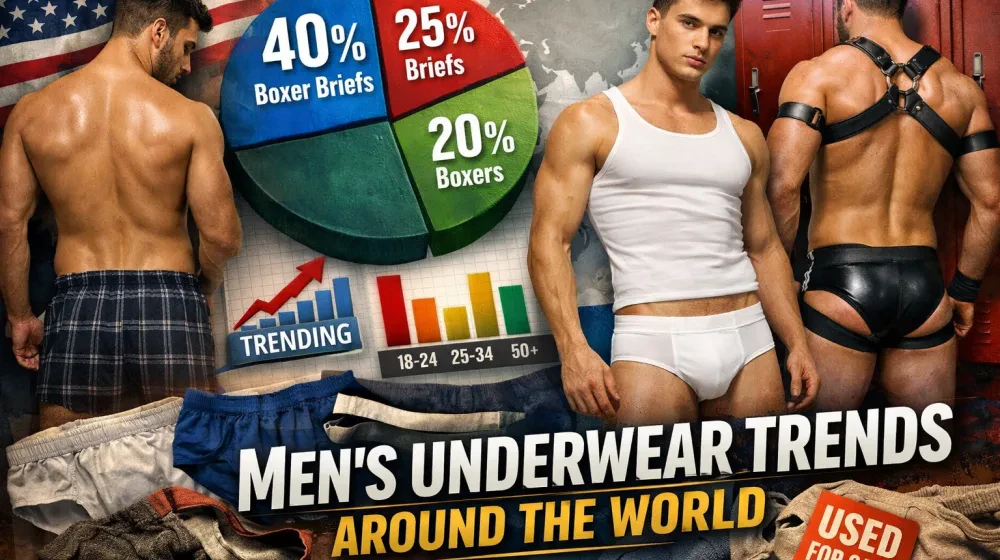
Market segmentation reports for Europe frequently show boxer briefs as the largest segment (around ~40% in some segmentations). Briefs also remain more visible in countries where fitted silhouettes and swimwear-style cuts are culturally normal.
These are broad patterns (not absolutes), but they reflect what retail trends and market segmentations commonly show:
USA / Canada: boxer briefs dominate; briefs are growing again via “retro” and gym aesthetics.
UK / Ireland: boxers and boxer briefs lead; briefs sit in the middle rather than the fringe.
France / Italy / Spain: briefs and fitted trunks are more culturally normal; less stigma around high-cut legs.
Germany / Nordics: mixed drawers; comfort-first buying.
Japan / South Korea: fitted trunks and sleek briefs are common; fabric tech and styling matter.
Brazil: briefs and body-hugging cuts remain popular, influenced by swimwear culture.
Australia: boxer briefs dominate, with increased jockstrap visibility in fashion and nightlife.
The key point: underwear preference isn’t only personal taste — it’s shaped by fashion norms, climate, sport culture, and masculinity narratives.
Underwear by Age: What Men Wear Changes Over Time
A simple rule that holds up surprisingly well: younger men experiment more; older men optimize for comfort and support — and many come back to briefs later in life.
18–24: trunks and boxer briefs dominate; more experimentation (fashion briefs, jocks for nights out, bold waistbands).
25–34: boxer briefs become the workhorse for daily life; this group is also more likely to buy premium pairs online.
35–49: comfort-first buying; boxer briefs remain strong, but many re-introduce briefs for support.
50+: briefs often rise again: support, habit loyalty, and “I know what works.”
Underwear becomes less about trends and more about routine — unless kink or fashion is a deliberate part of your identity.
The Brief Comeback & the Jockstrap Mainstreaming
For years, the cultural script was: boxers = “straight default” and briefs = “old-school” (or loaded with stereotypes). That script is fading fast.
Why briefs are back:
Retro fashion cycles: 90s/00s revival, higher-cut silhouettes, visible waistbands.
Gym culture: legs and glutes are trained more openly; briefs frame the body in a way boxers don’t.
Body confidence: younger generations care less about rigid masculinity rules.
Fabric tech: modern briefs are worlds away from stiff “tighty whities.”
And jockstraps? Fashion media has documented the jockstrap moving from athletic gear and queer subculture into mainstream menswear. It’s still a bold choice, but it’s no longer “underground” the way it was even a decade ago.
Why Underwear Is So Sexy Now (The Kink Psychology)
Underwear sits in a perfect psychological sweet spot: it’s intimate, symbolic, and almost revealing — without being fully explicit. In kink spaces, that makes it powerful.
Underwear is the closest garment to the body’s sexual center. Even a plain cotton brief feels personal because it touches skin where very few things do.
Full nudity is obvious. Underwear is teasing. It suggests shape, scent, and access without giving everything away — and that tension is a major erotic trigger.
For many people, the appeal isn’t just visual — it’s sensory. Worn underwear carries a real-world “signature” (scent, warmth, lived-in authenticity). That’s one reason the used market exists at all.
Different cuts signal different vibes:
Boxers: relaxed, casual, “boy-next-door.”
Boxer briefs: athletic, modern, “date-ready.”
Briefs: confident, classic, “I know what I’m doing.”
Jockstraps: bold, sexual, sport-coded, and strongly linked to gay kink culture.
Underwear can also be about power: wearing someone else’s, choosing what someone wears, controlling access, or exchanging intimate items as a consent-based form of ownership play.
Health Myth: Boxers vs Briefs
You’ll see the fertility debate everywhere: “Are boxers better?” Some research suggests looser underwear can be associated with lower scrotal temperature and, in certain studies, better sperm measures — but overall health factors (sleep, stress, weight, heat exposure, lifestyle) often matter more than one garment choice. If you’re trying to conceive and want a low-effort tweak, looser fits are a reasonable experiment. If you’re choosing underwear for comfort and confidence, you’re not “doing it wrong.”
The Used Underwear Boom (and Why It’s Not Going Away)
The used gear market has grown alongside social platforms, creator culture, and kink communities. It thrives because it offers what porn can’t: authenticity. It’s personal, real, and tied to someone’s identity.
For buyers, it’s sensory and emotional. For sellers, it can be a discreet way to monetize a wardrobe.
If you’re curious about the fetish side of underwear, start here: Underwear Kink on TFN. If you want to explore the marketplace side, head to TFN Marketplace — and if briefs are your thing specifically, see Used Briefs.
Want a deeper read? You may also like: The Underwear Fetish: Briefs & Masculinity and Sell Your Used Socks, Underwear & Fetish Gear.
Quick Takeaways
Boxer briefs are the modern global default: support + coverage.
Briefs never truly disappeared — and they’re getting hotter culturally.
Jockstraps are expanding from sport + subculture into fashion and kink.
Underwear is sexy because it’s intimate, suggestive, sensory, and identity-coded.
If you’re exploring this world, you don’t have to do it alone. Join The Fetish Network and find people who are into the same gear, the same aesthetics, and the same rules (consent first, always).